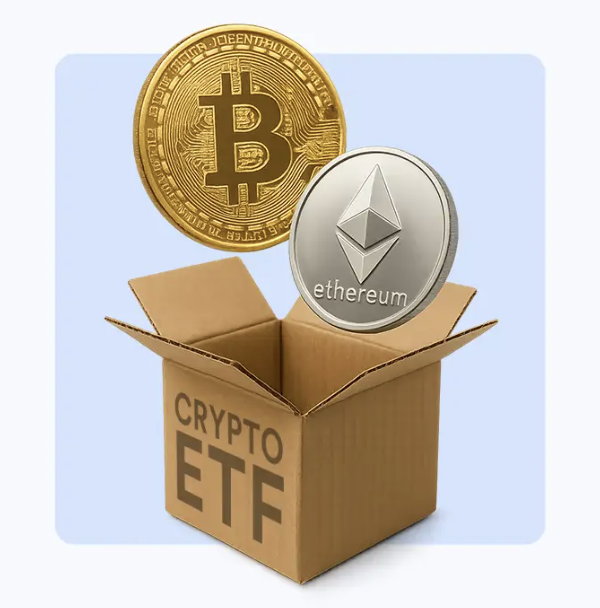

The cryptocurrency market has exploded over the past 18 months. Bitcoin hit record highs above $125,000. Ethereum dominates decentralized finance. Yet many investors still feel confused about how to gain crypto exposure safely.
The answer? Cryptocurrency ETFs.
A crypto ETF is the simplest way to invest in digital assets without managing private wallets, security concerns, or complicated exchanges. You buy crypto like you’d buy stocks—through your regular brokerage account. The ETF handles everything else.
But which crypto ETF should you choose? There are now dozens available. Some focus on Bitcoin alone. Others diversify across multiple cryptocurrencies. Some expose you to blockchain companies instead of crypto directly. Some invest in crypto futures, adding complexity and risk.
This comprehensive guide breaks down every type of crypto ETF, explains what makes each valuable, and helps you choose the right one for your investment goals and risk tolerance.
What Is a Cryptocurrency ETF? Simple Definition
A cryptocurrency ETF (exchange-traded fund) is an investment fund that holds cryptocurrencies or crypto-related assets and trades on stock exchanges like regular stocks.
Here’s how they differ from buying crypto directly:
Direct crypto ownership: You buy Bitcoin or Ethereum on a crypto exchange, store it in a digital wallet, manage security yourself. Crypto ETF: You buy shares through your brokerage (Fidelity, Charles Schwab, etc.), the ETF provider holds the actual crypto, you get tax efficiency and peace of mind.
Think of it like the difference between buying physical gold bars versus owning a gold ETF. You get the same exposure, but one is infinitely simpler.
Why This Matters for You
The SEC began approving Bitcoin and Ethereum ETFs in 2024, giving investors a new way to get the two largest cryptocurrencies in their portfolios. This regulatory approval transformed crypto investing from complicated to accessible.
You no longer need technical knowledge about blockchain, wallets, or exchanges. You don’t worry about losing your private keys. You get professional custody and insurance protection. Your assets are secure and accessible through any standard brokerage.
Types of Crypto ETFs Explained
Not all crypto ETFs are created equal. Understanding the different categories helps you pick the right fit.
Bitcoin ETFs (Single-Asset)
Bitcoin ETFs hold only Bitcoin (BTC). Bitcoin ETFs are the largest type, giving you direct exposure to the cryptocurrency.
These are ideal for investors who believe Bitcoin is the most important cryptocurrency and want simplicity. Bitcoin has the longest track record, the most institutional adoption, and dominates crypto market capitalization (around 50%).
Popular Bitcoin ETF options include Grayscale Bitcoin Mini Trust (BTC), Fidelity Bitcoin ETF (FBTC), and ProShares Bitcoin ETF (BITO).
Ethereum ETFs (Single-Asset)
Ethereum ETFs, which invest solely in Ethereum, follow Bitcoin ETFs as the second-largest category. Ethereum is the second-largest cryptocurrency and the foundation of decentralized finance (DeFi).
Ethereum’s unique value proposition is smart contracts—code-based agreements that execute automatically. This powers thousands of decentralized applications, from lending protocols to gaming platforms.
Choose an Ethereum ETF if you want exposure to DeFi, which is growing rapidly as institutions adopt blockchain technology.
Multi-Cryptocurrency ETFs
These hold multiple cryptocurrencies (typically the 10 largest), providing broader exposure and reducing concentration risk.
The recently launched Bitwise 10 Crypto Index ETF holds 10 crypto assets including bitcoin, ether, XRP, solana, chainlink and litecoin, with 90% of holdings allocated to bitcoin and ether.
Multi-crypto ETFs work for investors who believe in cryptocurrency broadly but want diversification across different blockchain projects with different use cases.
Crypto-Related Companies ETFs
The Schwab Crypto Thematic ETF provides exposure to companies that could benefit from the utilization of cryptocurrencies and digital assets, holding more than 40 stocks in companies with business activities connected to blockchain and digital assets.
These don’t hold cryptocurrency directly. Instead, they hold stocks of companies benefiting from crypto adoption (like MicroStrategy, which owns Bitcoin; Coinbase, a crypto exchange; or CleanSpark, a Bitcoin miner).
This approach appeals to investors who are crypto-curious but prefer traditional equity market exposure.
Crypto Futures ETFs
Some ETFs invest in Bitcoin or Ethereum futures contracts (bets on future prices) rather than holding actual cryptocurrency.
Futures ETFs are riskier and more complex than spot ETFs. They’re better suited for experienced investors. For most investors, spot ETFs (which hold actual crypto) are preferable.
Decentralized Finance (DeFi) ETFs
DeFi ETFs track indexes of the largest decentralized finance crypto assets. Holdings include Uniswap, Maker, Lido, Aave and other tokens, selected based on market capitalization, liquidity, and security standards.
DeFi tokens power the ecosystem of lending, borrowing, and trading platforms operating without central intermediaries. This is crypto’s fastest-growing sector.
Best Crypto ETFs for 2025: Complete Breakdown
Grayscale Bitcoin Mini Trust (BTC) – Best for Bitcoin Purists
Fund Type: Bitcoin Spot ETF Assets Under Management: $30+ Billion Expense Ratio: 0.20% Minimum Investment: One share (variable price) Holdings: 100% Bitcoin
Grayscale is the largest and most trusted crypto asset manager, backed by DCG (Digital Currency Group). Their Bitcoin Mini Trust is specifically designed for individual investors seeking direct Bitcoin exposure.
Key Features: Insured custody through Coinbase. Regular third-party audits. No redemption fees. No storage concerns. Tax-efficient structure.
Why Choose It: Grayscale’s reputation and size make BTC the safest Bitcoin-only option. The low 0.20% expense ratio is extremely competitive. Perfect for investors convinced Bitcoin is digital gold and a hedge against inflation.
Fidelity Bitcoin ETF (FBTC) – Best for Mainstream Investors
Fund Type: Bitcoin Spot ETF Expense Ratio: 0.25% Minimum Investment: One share Holdings: 100% Bitcoin Custody: Fidelity Digital Assets
Fidelity is a mainstream investment powerhouse. Their Bitcoin ETF opened the door to institutional and retail investors who wanted crypto exposure without switching platforms.
Key Features: Trade on major exchanges. Fidelity’s established reputation. Direct Bitcoin backing. Institutional-grade custody and insurance.
Why Choose It: If you already have a Fidelity brokerage account, FBTC is seamlessly integrated. You avoid learning new platforms. Fidelity’s infrastructure is proven and trusted.
iShares Bitcoin Trust (IBIT) – Best for Accessibility
Fund Type: Bitcoin Spot ETF Expense Ratio: 0.19% Minimum Investment: One share Holdings: 100% Bitcoin Provider: BlackRock (largest asset manager globally)
BlackRock’s entrance into crypto legitimized the sector for institutional investors. IBIT is accessible through any major brokerage and has attracted billions in flows.
Key Features: Backed by BlackRock’s $11 trillion AUM. Tradeable everywhere. Highest liquidity. Lowest fee available.
Why Choose It: Pure accessibility. BlackRock’s institutional credibility brings legitimacy. Widest trading options.
Ethereum ETF (ETHE/ETH) – Best for DeFi Believers
Fund Type: Ethereum Spot ETF Expense Ratio: 0.25% Minimum Investment: One share Holdings: 100% Ethereum Available Through: Major brokerages
Ethereum powers decentralized finance—a multi-trillion-dollar emerging ecosystem. If you believe DeFi will transform financial services, Ethereum exposure makes sense.
Key Features: Same custody and insurance as Bitcoin ETFs. Direct Ethereum backing. Pure-play DeFi exposure.
Why Choose It: Ethereum introduced smart contracts—self-executing agreements with the terms directly written into code—and has established itself as the leading platform for decentralized finance and non-fungible tokens, attracting developers.
Bitwise 10 Crypto Index ETF (BITW) – Best for Diversification
Fund Type: Multi-Cryptocurrency Index ETF Expense Ratio: 2.50% Minimum Investment: One share Holdings: Bitcoin (70.83%), Ethereum (20.65%), Solana (4.21%), XRP (1.72%), and Avalanche (0.59%) Assets Under Management: $5+ Billion
Bitwise 10 provides exposure to the top 10 cryptocurrencies by market cap, reducing concentration risk while maintaining exposure to Bitcoin and Ethereum dominance.
Key Features: Monthly rebalancing. Diversified across different blockchain use cases. Professional selection process. Regulated custody through Coinbase.
Why Choose It: If you believe in cryptocurrency broadly but want to reduce Bitcoin concentration risk, Bitwise 10 is ideal. You get exposure to emerging blockchain platforms (Solana for speed, Polkadot for interoperability) without the complexity of owning 10 individual cryptos.
Schwab U.S. Crypto Thematic ETF (IDIT) – Best for Conservative Investors
Fund Type: Crypto-Related Stocks Expense Ratio: 0.84% Minimum Investment: One share Holdings: 40+ crypto-adjacent companies
This ETF holds traditional stocks of companies benefiting from crypto adoption—Bitcoin miners, exchange operators, blockchain developers—rather than cryptocurrency itself.
Key Features: Lower volatility than direct crypto. Equity market familiarity. Dividend potential from profitable companies.
Why Choose It: If you want crypto exposure but feel uncomfortable holding digital assets directly, IDIT bridges the gap. You get upside from crypto adoption without direct cryptocurrency holdings.
Grayscale Digital Large Cap Fund (GDLC) – Best for Institutions & Large Investors
Fund Type: Multi-Crypto Fund Expense Ratio: 2.50% Minimum Investment: Varies (typically $25,000+) Holdings: Bitcoin (70.83%), Ethereum (20.65%), Solana (4.21%), XRP (1.72%), and Avalanche (0.59%)
Grayscale’s premium fund for serious investors seeking professional management of top-performing cryptocurrencies.
Key Features: Uses multi-signature wallets and cold storage custody through Coinbase, with regular third-party audits and insurance coverage for digital assets. Experienced management team. Proven track record.
Why Choose It: For investors with significant capital (25k+), this fund offers institutional-grade management with crypto specialization.
Crypto ETF Investment Strategy by Risk Profile
Conservative Investors (Low Risk Tolerance)
Allocation approach: 90% stocks, 10% bonds, 5% crypto ETFs (within investment portfolio).
Recommended ETFs: Schwab Crypto Thematic (IDIT), Bitcoin ETF (BTC), or skip crypto entirely.
Rationale: For most investors, there is a strong case to be made for crypto remaining only a modest part of a broadly diversified portfolio, with a good rule of thumb being to allocate no more than 5% to crypto.
Strategy: Make a small, fixed allocation to crypto as a diversifier. Don’t chase performance. Don’t increase allocation during hype periods.
Moderate Investors (Medium Risk Tolerance)
Allocation approach: 70% stocks, 20% bonds, 10% crypto ETFs.
Recommended ETFs: Mix of Bitcoin (60%) and Ethereum (40%) ETFs, or single Bitwise 10 Crypto ETF.
Rationale: This allocation captures crypto upside while limiting portfolio volatility.
Strategy: Invest a fixed amount monthly (dollar-cost averaging). Rebalance annually. Don’t panic sell during downturns.
Aggressive Investors (High Risk Tolerance)
Allocation approach: 60% stocks, 20% bonds, 20% crypto ETFs.
Recommended ETFs: Bitwise 10 Crypto ETF (diversified), individual Bitcoin + Ethereum + Solana ETFs, or DeFi crypto ETFs.
Rationale: Bitcoin’s decentralized nature, fixed supply of 21 million coins, and high security through proof-of-work consensus make it a hedge against inflation and economic uncertainty, with Bitcoin’s role as a reserve asset and increasing institutional adoption expected to drive enduring interest.
Strategy: Explore emerging cryptocurrencies through multi-crypto ETFs. Consider smaller allocations (5-10%) to higher-risk DeFi tokens if interested.
How Crypto ETFs Compare to Direct Crypto Ownership
Why Choose Crypto ETFs Over Direct Crypto Ownership
Simplicity: No wallets, security keys, or exchanges to understand.
Security: Professional custody eliminates private key management risk.
Tax Efficiency: Built-in tax accounting. Easy for tax reporting.
Insurance: ETF custodians carry insurance. Direct crypto often doesn’t.
Accessibility: Trade like stocks through any brokerage.
Regulation: ETFs are SEC-regulated. More investor protections.
Why Some Choose Direct Crypto Ownership
Ultimate control: You own your private keys.
Lower fees: No ETF expense ratio (though exchange/wallet fees apply).
Maximum flexibility: Trade on any exchange, send anywhere, any time.
Staking rewards: Some cryptocurrencies reward holding directly (not available in ETFs).
Trading options: Direct crypto allows margin trading and other advanced features.
Verdict: For most investors, crypto ETFs make sense. Direct ownership suits experienced crypto enthusiasts prioritizing control over convenience.
Crypto ETF Performance 2024-2025
Bitcoin ETF performance has been exceptional. Investors who bought Bitcoin ETFs in January 2024 nearly tripled their investment by October 2025 as Bitcoin climbed from $40,000+ to $125,000+.
However, volatility is the norm for cryptocurrency prices, which often experience rapid and significant fluctuations.
2025 has been a good year for Bitcoin. The largest cryptocurrency by market cap has notched several record highs (despite some periods of intense volatility).
Past performance doesn’t guarantee future results. Crypto markets are cyclical, with bull runs followed by sharp corrections.
Tax Implications of Crypto ETF Investing
Capital Gains Treatment
Crypto ETF profits are taxed as capital gains. If you hold the ETF for less than one year, profits are short-term capital gains (taxed as ordinary income). Holding longer than one year qualifies for long-term capital gains rates (typically 15-20%).
Tax-Advantaged Accounts
Investing in crypto ETFs through a Roth IRA allows tax-free withdrawals, enhancing your retirement savings.
Strategy: Purchase crypto ETFs within Roth IRAs or Traditional IRAs to avoid yearly tax reporting on gains. You only pay taxes (or avoid them) when you withdraw in retirement.
Dividend and Distribution Tracking
Keep records of all purchases, sales, and dividend distributions. Most brokerages provide tax reporting documents automatically.
Pros and Cons of Crypto ETFs
Advantages
Simple, stocks-like trading. No wallet or security management. Professional custody and insurance. Tax-efficient structures. Accessible through any broker. Instant liquidity. Regulatory oversight and investor protections. Low fees (0.2-0.8% for single-crypto ETFs).
Disadvantages
Less control than direct ownership. Cannot access crypto directly (no staking in most cases). Still subject to crypto market volatility. Expense ratios reduce returns (though usually minimal). Limited selection compared to thousands of cryptos available directly.
Common Mistakes Crypto ETF Investors Make
Buying at Peak Hype
Bitcoin surged to $125,000 in 2025. Many investors who bought near peaks in 2021 saw 80%+ declines before recovery.
Avoid this: Dollar-cost average (invest fixed amounts monthly regardless of price). Don’t invest a lump sum right after major rallies.
Overallocating to Crypto
Some investors put 50%+ of portfolios into crypto ETFs. This violates basic diversification principles.
Better approach: Even so, many investors opt for a smaller allocation, often in the 1% to 3% range.
Trading Too Frequently
The fees and tax consequences of frequent trading kill returns. ETFs are designed for buy-and-hold investing.
Smart move: Set an allocation, invest consistently, rebalance annually. Resist the urge to time the market.
Ignoring Volatility
Crypto ETFs can drop 20-30% in weeks. If this causes panic selling, you’ll lock in losses.
Reality check: Volatility is nothing new for crypto investors, with Bitcoin climbing above $125,000 before experiencing several sharp drops—peak to trough, a decline of over $40,000 from its record high.
Only invest amounts you can afford to hold through downturns.
FAQ: Crypto ETF Questions Answered
Can I buy crypto ETFs in a Roth IRA?
Yes, absolutely. Purchase crypto ETFs within your Roth IRA just like you’d buy stock ETFs. This is powerful—gains grow tax-free and withdrawals in retirement are tax-free.
What’s the minimum investment in crypto ETFs?
Usually just one share. The share price varies ($500-$2,000 typically). You can invest small amounts through fractional shares offered by most brokers.
Which crypto ETF has the lowest fees?
Bitcoin and Ethereum spot ETFs from providers like Fidelity, BlackRock, and Grayscale have expense ratios of 0.19%-0.25%. Multi-crypto ETFs charge higher fees (1.5-2.5%) to cover active management.
Is crypto ETF investing safe?
As safe as any stock ETF. Your assets are held in professional custody with insurance. Regulatory oversight protects investors. The risk is price volatility, not theft or loss.
Should I buy Bitcoin or Ethereum ETF first?
Bitcoin is less risky (longer track record, larger market cap). Ethereum is higher-upside (DeFi growth potential). Most investors do 70-80% Bitcoin, 20-30% Ethereum.
Can I lose all my money in a crypto ETF?
Theoretically, cryptocurrency could fall to zero. Practically, Bitcoin and Ethereum becoming worthless would require massive global shifts in how we view money and finance. Unlikely, but not impossible. Only invest what you can afford to lose.
What’s the difference between spot ETFs and futures ETFs?
Spot ETFs hold actual cryptocurrency. Futures ETFs use derivatives (bets on future prices). Spot ETFs are simpler and suitable for most investors. Futures add complexity and risk.
How often should I rebalance a crypto ETF allocation?
Once per year. Check if your crypto holdings have grown beyond your target allocation (e.g., from 10% to 15% of your portfolio). If so, trim the position and buy underweighted investments to rebalance.
Can I make money if crypto prices fall?
Yes, through inverse crypto ETFs that profit when prices drop. However, these are complex and usually underperform as long-term holds. Better approach: If bearish on crypto, simply reduce allocation rather than short the market.
Conclusion: Your Crypto ETF Investment Plan
Crypto ETFs democratized cryptocurrency investing. You no longer need technical expertise, expensive equipment, or days of research. You simply choose an ETF matching your beliefs and risk tolerance, then invest.
Start with your allocation. Conservative investors: 2-5% in Bitcoin ETF. Moderate investors: 8-10% split between Bitcoin and Ethereum. Aggressive investors: 15-20% across multiple crypto ETFs.
Open a Roth IRA if you don’t have one and purchase crypto ETFs there. Tax-free growth is powerful over decades.
Invest consistently through dollar-cost averaging. Ignore price swings. Rebalance annually. Long-term wealth compounds beautifully.
The crypto revolution isn’t coming—it’s already here. Bitcoin hit all-time highs. Ethereum powers a multi-billion-dollar DeFi ecosystem. Institutional adoption accelerates. Whether you allocate 2% or 20% to crypto, ETFs make it simple.
Ready to start? Open your brokerage, search “Bitcoin ETF,” and invest your first share today.